Michael Faraday devoted much of his scientific career to understanding the relationship between electricity and magnetism, investigating how magnetic forces could influence different materials and even light itself. In 1845, his experiments led to two major discoveries: diamagnetism, demonstrating that even materials not conventionally considered magnetic could respond to a magnetic field, and the magneto-optical effect, which showed that magnetism could influence the behaviour of light. These investigations contributed significantly to his development of the electromagnetic field theory, one of the foundations of modern physics.
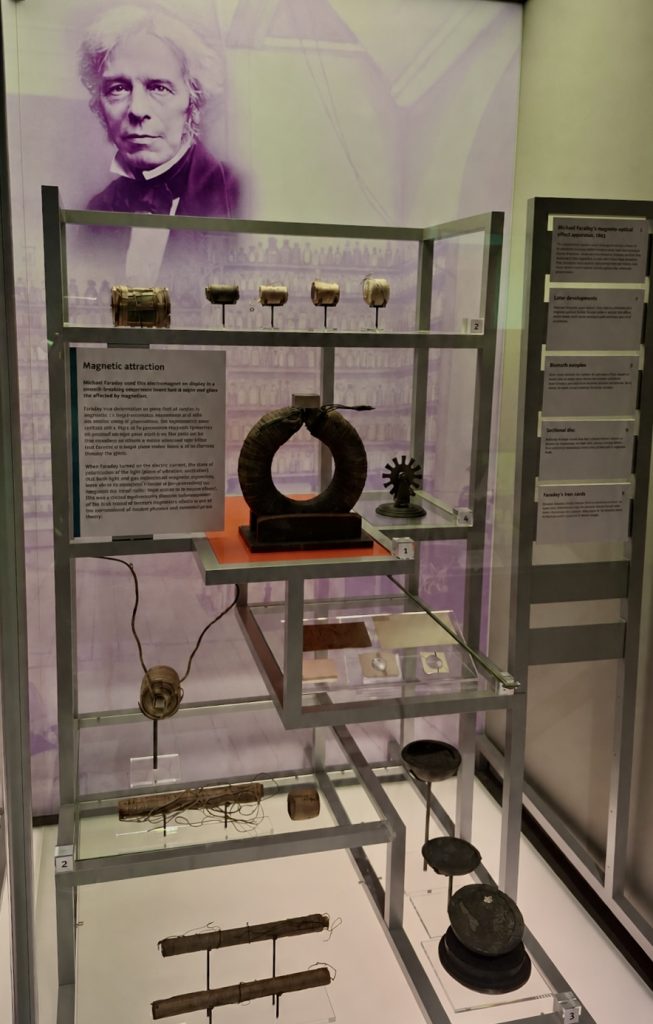
The display brings together several instruments and materials used to explore these phenomena. At its centre stands a large electromagnet, made from an iron core wrapped in heavy wire, which generated a powerful magnetic field. Faraday used this apparatus in his experiments with a block of dense glass, demonstrating that passing polarised light through the glass while it was exposed to a magnetic field caused its plane of polarisation to rotate. This phenomenon became known as the Faraday Effect. Other objects on display, including smaller electromagnetic coils, bismuth samples, iron cards and experimental discs, illustrate his investigations into magnetic attraction, repulsion and the different ways in which materials respond to magnetic forces. Together, these instruments offer a glimpse into Faraday’s experimental approach and his determination to uncover the fundamental connections between the forces of nature.