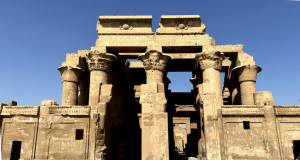
Kom Ombo takes its name from the Arabic kum, meaning “mound”, and Ombo, which ultimately derives from the ancient Egyptian name of the city, Nubt, meaning “Golden City”. The city’s temple is uniquely dedicated to two deities: the crocodile god Sobek, whose sanctuary occupies the southern side of the complex, and the falcon god Harwer (Horus the Elder, known to the Greeks as Haroeris), whose sanctuary is on the northern side.
Among the many remarkable features of the temple, perhaps the most famous is the relief depicting a collection of surgical instruments. This unique scene provides valuable insight into the sophistication of ancient Egyptian medicine and healing practices.
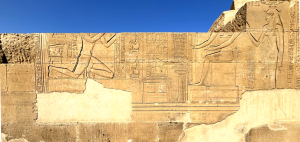
The relief was most likely carved during the Roman period, between the reigns of the emperors Antoninus Pius and Macrinus (AD 138-218). The emperor, shown kneeling on the left, appears before an enthroned deity, generally identified as Harwer. This identification is supported by the location of the relief within the northern half of the temple, which was dedicated to Harwer rather than Sobek. It is also consistent with Harwer’s association with healing and medicine at Kom Ombo, where several inscriptions refer to him as the “Head of Physicians”.
Although the object being presented by the emperor is no longer preserved, the accompanying inscriptions make it clear that it originally consisted of a pair of wedjat-eyes. The wedjat is the Eye of Horus, which according to ancient Egyptian mythology was damaged during Horus’s conflict with Set and later restored. Because of its restoration, the eye became a powerful symbol of healing, wholeness, and the triumph of order over chaos.
In this scene, the two wedjat-eyes symbolise Upper and Lower Egypt. By presenting the restored eyes to the gods, the king symbolically offers them a united, prosperous, and protected Egypt.
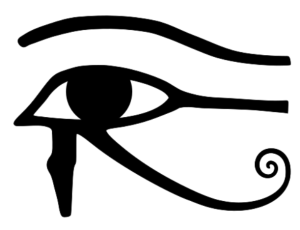
Usually depicted as the left eye of Horus and often paired with the Eye of Ra as its counterpart, the wedjat was one of the most important symbols in ancient Egyptian religion. It represented well-being, protection, and healing. Its significance originated in the mythological struggle between Horus and Set, during which Horus lost or damaged one of his eyes. The eye was subsequently restored, often with the assistance of the god Thoth.
After its restoration, Horus presented the eye to his deceased father Osiris, whose revitalisation in the afterlife was sustained through its power. As a symbol of healing and restoration, the wedjat became closely associated with medicine and continued to serve as a powerful protective amulet throughout Egyptian history.
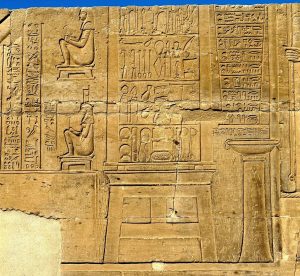
On the left side of the relief are two figures seated on delivery chairs, generally thought to represent the goddesses Isis and Nephthys. On the right stands a basin mounted on a pedestal. At the lower centre is a representation of a table, while the panel above depicts the instruments that would have been placed upon it.
The collection includes scalpels, saws, hooks, forceps, a sponge, and a variety of vessels. Together, these objects provide one of the most celebrated visual records of medical instruments from the ancient world and demonstrate the advanced state of Egyptian medical knowledge.
The delivery chairs shown in the relief closely resemble the Roman sella obstetricia, a specialised birthing chair used throughout the Roman world. These chairs were equipped with armrests for the woman to grip and featured a crescent-shaped or circular opening in the seat to facilitate childbirth and allow fluids to drain away.
During labour, a woman would typically rest on a low, firm bed. When delivery became imminent, she would be moved to the birthing chair. Ancient medical authorities believed that an upright position aided the birth process and made delivery easier and more effective.
The physician Soranus of Ephesus (c. AD 98-138), one of the most important medical writers of the Roman period, recommended that a midwife be assisted by three women. Two assistants would stand on either side of the birthing chair, while the third stood behind it, gently supporting the woman and helping her remain steady during labour. The midwife herself sat facing the woman, positioned slightly lower in order to assist with the delivery.
The inclusion of these figures, together with the surgical instruments, highlights the close connection between healing, medicine, and childbirth within the religious context of the Temple of Kom Ombo. The scene remains one of the most fascinating representations of medical practice from ancient Egypt and offers a rare glimpse into the knowledge and techniques of physicians more than 1,800 years ago.
- Photos and main text by Malcolm Kinross (October 2026)
- Locate the item on this Google Map