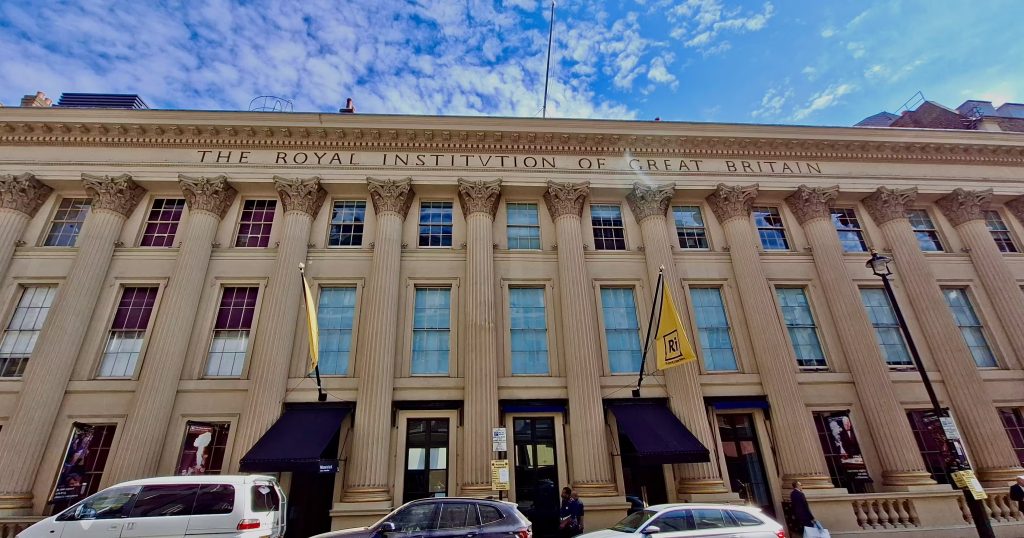
The Royal Institution of Great Britain
The Royal Institution has been at the forefront of scientific innovation, discovery and communication since its founding in 1799.
Established with the aim of promoting scientific knowledge and its practical applications, it has played a significant role in shaping the relationship between science and society. Throughout its history, it has been home to some of Britain’s most influential scientists, including
Michael Faraday and
Humphry Davy, whose groundbreaking discoveries helped shape modern science.
The Royal Institution connects the public with the scientific community through talks, events and activities designed for people of all ages and backgrounds. Among its most renowned initiatives are the CHRISTMAS LECTURES, established in 1825 by Michael Faraday, who played a fundamental role in developing this tradition of making science accessible and engaging to the general public.
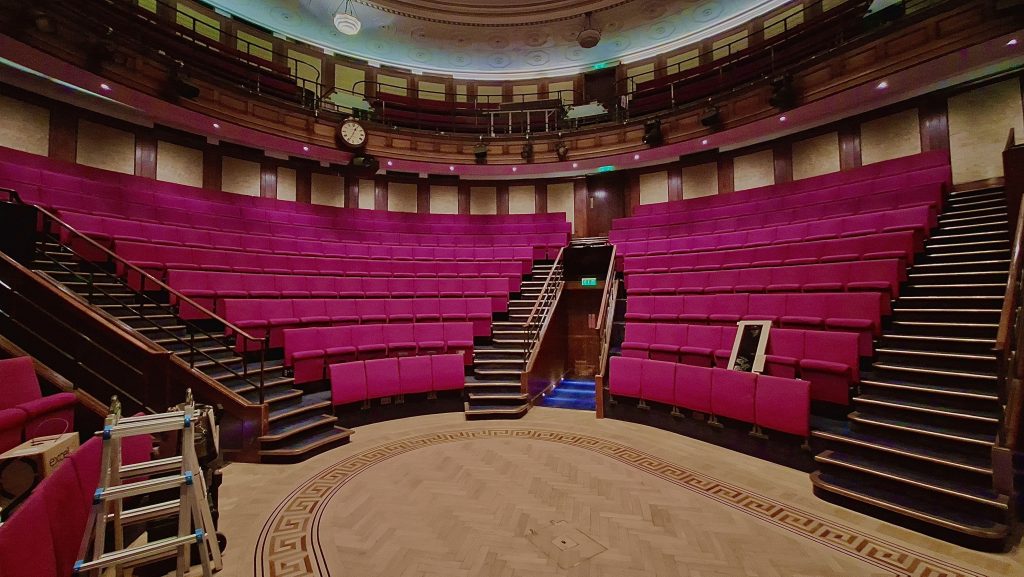
These lectures, together with the Friday Evening Discourses, have traditionally been held in the Institution’s historic Lecture Theatre. Designed by architect Thomas Webster in 1800, it is one of the most iconic spaces within the Royal Institution. Its distinctive steeply tiered seating, inspired by anatomical theatres, allows audiences to observe scientific demonstrations clearly from every position.
Since the nineteenth century, it has hosted some of the most important public science lectures in history, including the Friday Evening Discourses, initiated by Michael Faraday. These events provided an opportunity for scientists to present their discoveries and experiments to a wider audience, helping make science accessible to the general public.
The Theatre also witnessed remarkable scientific milestones. In 1831, Faraday presented his work on electromagnetic induction, while in 1897 J. J. Thomson announced the discovery of the electron during a Friday Evening Discourse.
Although the original Theatre was destroyed by an electrical explosion in 1927, it was subsequently rebuilt, preserving its original design and historical character.